
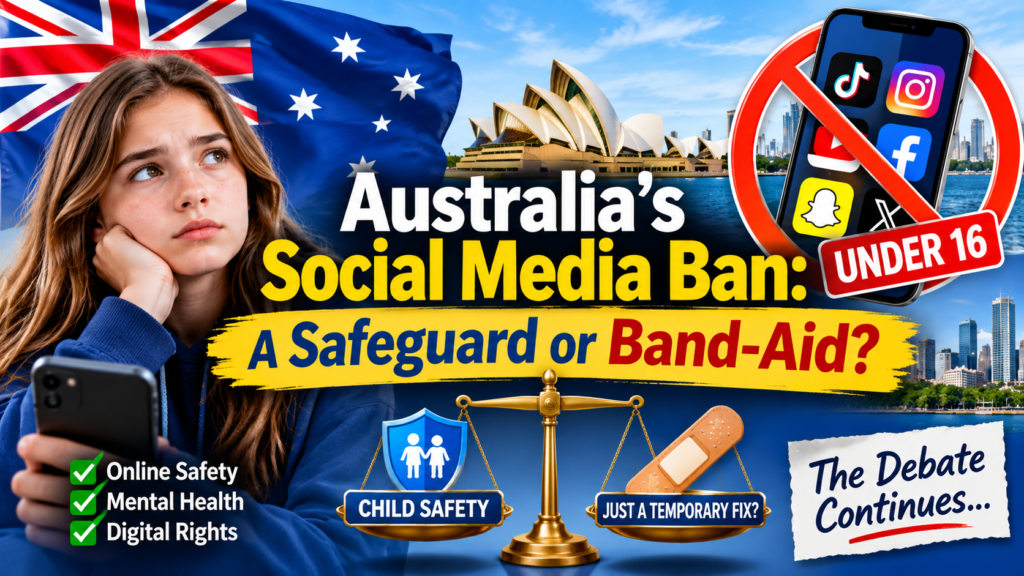
Australia has taken a bold step in addressing one of the most debated issues of the digital age: children’s exposure to social media.
On December 10, 2025, Australia’s world-first Social Media Minimum Age law came into effect, requiring major age-restricted social media platforms to take reasonable steps to prevent Australians under 16 from creating or maintaining accounts.
The policy has attracted international attention, sparked debates among parents and educators, and raised important questions about children’s mental health, digital rights, online safety, and the responsibilities of technology companies.
Supporters see the restriction as a necessary safeguard against cyberbullying, harmful content, addictive platform features, and online exploitation. Critics, however, question whether banning younger teenagers from social media addresses the underlying problems or simply places a temporary barrier between children and digital platforms.
The bigger question is this: Is Australia’s social media ban a meaningful safeguard for the next generation, or is it merely a band-aid covering a much deeper problem?
To understand the implications, we need to look beyond the headline and examine what the legislation does, what it aims to achieve, and whether restricting access is enough to make the online world safer for children.
1. Understanding Australia’s Under-16 Social Media Ban
Australia’s Social Media Minimum Age legislation was enacted in November 2024, with its obligations taking effect on December 10, 2025.
Under the law, age-restricted social media platforms must take reasonable steps to prevent Australians under 16 from holding accounts.
The responsibility falls on the platforms, not children or their parents.
Companies that fail to meet their legal obligations can face substantial civil penalties. As of November 2026, the maximum potential penalty for corporations is AUD $109.2 million, subject to the relevant legal process.
The law covers major platforms identified by Australia’s eSafety Commissioner, including:
- Snapchat
- TikTok
- YouTube
- X
- Threads
- Twitch
- Kick
Other services may also be classified as age-restricted as regulatory assessments continue.
However, the legislation does not prohibit all online activity for people under 16. Certain messaging, gaming, educational, health-related, and other services are excluded under the applicable rules.
Children can also access publicly available social media content that does not require an account.
Importantly, children under 16 and their parents or carers are not penalised for accessing an age-restricted account. The legal obligation is directed at the platform providers.
For the official explanation, see the Australian eSafety Commissioner’s Social Media Age Restrictions.
2. Why Did Australia Introduce the Social Media Ban?
The legislation emerged from growing concern about the influence of social media on children’s wellbeing and development.
For many young people, social media is part of everyday life. It provides opportunities to communicate, discover interests, express creativity, and connect with communities.
However, these benefits exist alongside significant risks.
Cyberbullying and Online Harassment
Social media can expose children to bullying that extends beyond school hours.
Hurtful comments, threatening messages, public humiliation, and the distribution of embarrassing images can follow young people wherever they access the internet.
Unlike traditional bullying, online harassment can spread rapidly and reach large audiences.
Exposure to Harmful Content
Young users may encounter content involving violence, self-harm, eating disorders, dangerous challenges, misinformation, and other potentially harmful material.
Even when platforms introduce content moderation systems, harmful material can still appear in feeds, recommendations, and shared posts.
Social Comparison and Mental Wellbeing
Social media often presents carefully selected images of people’s appearances, lifestyles, achievements, and experiences.
For younger users who are still developing their identities and self-esteem, constant comparison can contribute to feelings of inadequacy, anxiety, and dissatisfaction.
Excessive Screen Time and Platform Engagement
Many social media platforms are designed to encourage repeated engagement through notifications, recommendations, autoplay, and personalized feeds.
These features can make it difficult for some young users to manage their screen time, particularly when they are balancing school, sleep, exercise, and social activities.
Australia’s policy attempts to reduce some of these risks by delaying access to age-restricted social media accounts until users reach 16.
However, whether this approach produces lasting improvements in children’s wellbeing remains an important question.
3. The Safeguard Argument: Why Supporters Believe the Ban Matters
Supporters argue that children should not have to navigate complex digital environments without sufficient protection.
The social media ban represents an attempt to shift more responsibility from families to the companies operating these platforms.
Giving Children More Time to Develop
Childhood and early adolescence are important stages of emotional, social, and cognitive development.
Supporters believe delaying social media access may give young people additional time to develop confidence, emotional regulation, critical thinking, and healthy relationships outside algorithm-driven environments.
Reducing Exposure to Online Risks
Restricting account access can reduce some opportunities for unwanted contact, targeted interactions, and exposure to certain platform features.
Although it cannot eliminate all online risks, limiting access to major social media accounts may create an additional protective barrier.
Holding Technology Companies Accountable
One of the strongest arguments supporting Australia’s approach is that it places legal responsibility on social media companies.
For years, parents, schools, and child safety advocates have raised concerns about platform design, moderation, recommendation systems, and the difficulty of protecting younger users.
The legislation sends a clear message: technology companies have responsibilities when their services are used by children.
This is an important shift in the debate about digital safety.
Encouraging More Offline Activities
Reducing social media use may encourage some teenagers to spend more time participating in:
- Sports and physical activities.
- Face-to-face friendships.
- Family interactions.
- Creative hobbies.
- Reading and educational activities.
- Community involvement.
These activities can support social development and healthy routines.
However, these benefits are not automatic. Young people need meaningful alternatives, supportive environments, and opportunities to participate.
4. The Band-Aid Argument: Does Restricting Access Solve the Real Problem?
While the policy has protective intentions, critics argue that an age restriction alone cannot address the structural problems associated with social media.
A ban may limit access to certain platforms, but it does not necessarily change the technology, business models, and online environments that create risks.
Children Can Still Find Ways Around Restrictions
One of the major challenges is enforcement.
Young users may attempt to bypass age restrictions through false birth dates, alternative accounts, shared devices, or other methods.
A July 2026 Reuters report highlighted concerns about age-assurance systems, after independent testers reportedly created accounts on several restricted platforms without being asked to provide age evidence.
This illustrates an important challenge: a law may establish a minimum age, but effective implementation depends on whether platforms can reasonably enforce it.
The Problem May Shift to Other Online Spaces
Restricting access to major social media platforms does not remove children’s access to the internet.
Young people may move to alternative services, online communities, gaming environments, or websites that are not covered by the restrictions.
Some of these spaces may offer fewer protections or less effective moderation.
The result could be a shift in where risks occur rather than their complete elimination.
Digital Literacy Is Still Necessary
Children will eventually reach the age when they can legally create social media accounts.
If they have not developed the skills to identify misinformation, recognize manipulation, protect personal information, manage online interactions, and respond to harmful content, they may remain vulnerable.
Digital literacy should therefore be taught alongside age restrictions.
Children need to understand how digital platforms work, why online content can be misleading, and how to make responsible decisions.
Social Media Also Provides Positive Opportunities
Social media is not exclusively harmful.
For some young people, it provides access to educational information, creative communities, peer support, cultural connections, and opportunities to communicate with people who share similar experiences.
Some teenagers may also depend on online communities because they have limited access to supportive social environments offline.
A policy that restricts access must therefore consider not only the risks but also the potential loss of beneficial connections.
5. What Does the Early Evidence Say About Australia’s Social Media Ban?
An important question is whether the legislation is already producing measurable results.
As of November 2026, the available evidence suggests that the policy has had an early impact on account access, but its long-term effectiveness remains uncertain.
According to Australia’s eSafety Commissioner, the proportion of under-16s holding social media accounts declined from 52.4% before the restrictions to 42.1% at the three-month follow-up.
This represents a statistically significant reduction, but it also shows that a substantial proportion of children continued to report having accounts.
The findings were published in the first report of eSafety’s two-year evaluation project, involving more than 4,000 children and families.
The Commissioner has emphasized that the early findings cannot yet establish whether the policy will achieve its longer-term objectives.
Other research has also highlighted implementation challenges.
A study discussed by the University of Newcastle and published in the British Medical Journal in June 2026 found that many adolescents reported continued access to social media through existing, alternative, or shared accounts during the early implementation period.
Meanwhile, an October 2026 working paper from researchers studying the Australian policy reported low adherence among surveyed 14- and 15-year-olds, highlighting the importance of peer behaviour and social incentives.
These findings should be interpreted carefully because they use different research methods, samples, and definitions of compliance.
The evidence points to three important observations:
- The restrictions have reduced reported account access among under-16s.
- Enforcement and age-assurance challenges remain significant.
- It is too early to conclude that the policy has produced lasting improvements in mental health, safety, or overall wellbeing.
Australia’s experiment is still developing, and the next phase of research will be particularly important.
6. The Bigger Issue: Should Social Media Companies Change Their Business Models?
Perhaps the most important question is not simply whether children should use social media before turning 16.
It is whether social media platforms should be designed in ways that better protect all users, particularly younger audiences.
Many platforms rely on engagement-based business models.
The more time users spend watching, scrolling, interacting, and sharing, the more opportunities platforms may have to generate advertising revenue and collect engagement data.
This raises questions about the role of recommendation algorithms, personalized feeds, notifications, and content moderation.
A stronger approach to online safety could include:
- Safer Platform Design – Companies should examine whether their features encourage excessive engagement or expose young users to harmful content.
- Greater Algorithmic Transparency – Users, regulators, and independent researchers should have better opportunities to understand how recommendation systems influence what people see.
- Stronger Content Moderation – Platforms should invest in identifying and responding to harmful content, harassment, exploitation, and dangerous online behaviour.
- Better Privacy Protections – Children’s personal information should receive strong protection, and platforms should limit unnecessary data collection and profiling.
- Greater Corporate Accountability – Technology companies should be expected to demonstrate how their safety measures work, rather than relying exclusively on public statements about their commitments. Australia has begun exploring broader regulatory measures beyond the age restrictions.
In September 2026, the Australian Government released draft Digital Duty of Care legislation for targeted consultation. Its proposed initiatives include giving users more control over personalized social media feeds through the My Feed, My Way initiative.
This signals an important development: the policy debate is moving beyond age restrictions toward the responsibilities and design of digital platforms.
7. The Role of Parents, Schools, and Communities
Government legislation cannot replace parental guidance, education, or community involvement.
Children need adults who can help them understand the digital environment and develop healthy relationships with technology.
Parents: Build Open Communication
Parents should encourage conversations about online experiences without immediately turning every discussion into punishment.
Children need to feel comfortable reporting cyberbullying, inappropriate messages, harmful content, or uncomfortable interactions.
Schools: Teach Digital Citizenship
Schools can help students develop the skills needed to participate responsibly in digital environments.
Important topics include:
- Online privacy and personal information.
- Cyberbullying prevention.
- Misinformation and critical thinking.
- Responsible digital communication.
- Understanding algorithms.
- Recognizing online manipulation.
- Healthy technology habits.
Communities: Provide Meaningful Alternatives
Sports clubs, youth organizations, libraries, arts programs, and community groups can help young people develop interests and relationships outside digital platforms.
Restricting access is more meaningful when young people have opportunities to build confidence, friendships, and a sense of belonging elsewhere.
8. What Can Other Countries Learn From Australia’s Social Media Ban?
Australia’s policy is being closely watched by governments around the world.
Countries facing similar concerns about youth mental health, online exploitation, cyberbullying, and excessive social media use may consider introducing their own age restrictions.
However, copying the Australian model without considering local circumstances could create additional challenges.
Governments should consider:
- Cultural differences: Children’s digital habits, family structures, and educational environments differ across countries.
- Enforcement capabilities: Age-assurance systems require technical resources, privacy safeguards, and effective regulatory oversight.
- Digital rights: Policies should balance child protection with privacy, freedom of expression, access to information, and participation in digital communities.
- Education: Restrictions should be supported by digital literacy programs for children, parents, and teachers.
- Independent evaluation: Governments should measure both intended benefits and unintended consequences.
Australia’s experience demonstrates that regulating social media is not simply a technological challenge. It is also a social, educational, ethical, and public policy issue.
9. So, Is Australia’s Social Media Ban a Safeguard or a Band-Aid?
The answer may be both.
As a safeguard, the legislation represents a significant attempt to protect children from some of the risks associated with social media accounts and to make technology companies more accountable.
It recognizes that children should not carry the entire responsibility for navigating digital environments designed and operated by powerful technology companies.
However, as a complete solution, the policy has clear limitations.
It does not eliminate cyberbullying, remove harmful content from the internet, guarantee digital literacy, or address every design feature that may contribute to unhealthy online behaviour.
It may also create enforcement challenges and unintended consequences for young people who rely on online communities for information, education, or social connection.
The most effective approach is likely to combine reasonable age protections with stronger platform accountability, privacy safeguards, digital education, parental involvement, and independent research.
A ban can create a barrier, but lasting protection requires a safer digital environment.
Conclusion: Protecting Children Requires More Than a Ban
Australia’s social media ban has opened an important global conversation about the relationship between technology, childhood, mental health, and corporate responsibility.
Its long-term success will depend not only on how many under-16s lose access to restricted accounts but also on whether young people become safer, healthier, and better equipped to navigate the digital world.
Governments must continue evaluating the policy. Technology companies must improve their safety practices. Schools and parents must support digital literacy. Communities must provide young people with opportunities to build meaningful relationships beyond screens.
The objective should not simply be to keep children away from social media.
It should be to create an online environment where children can eventually participate safely, responsibly, and confidently.